
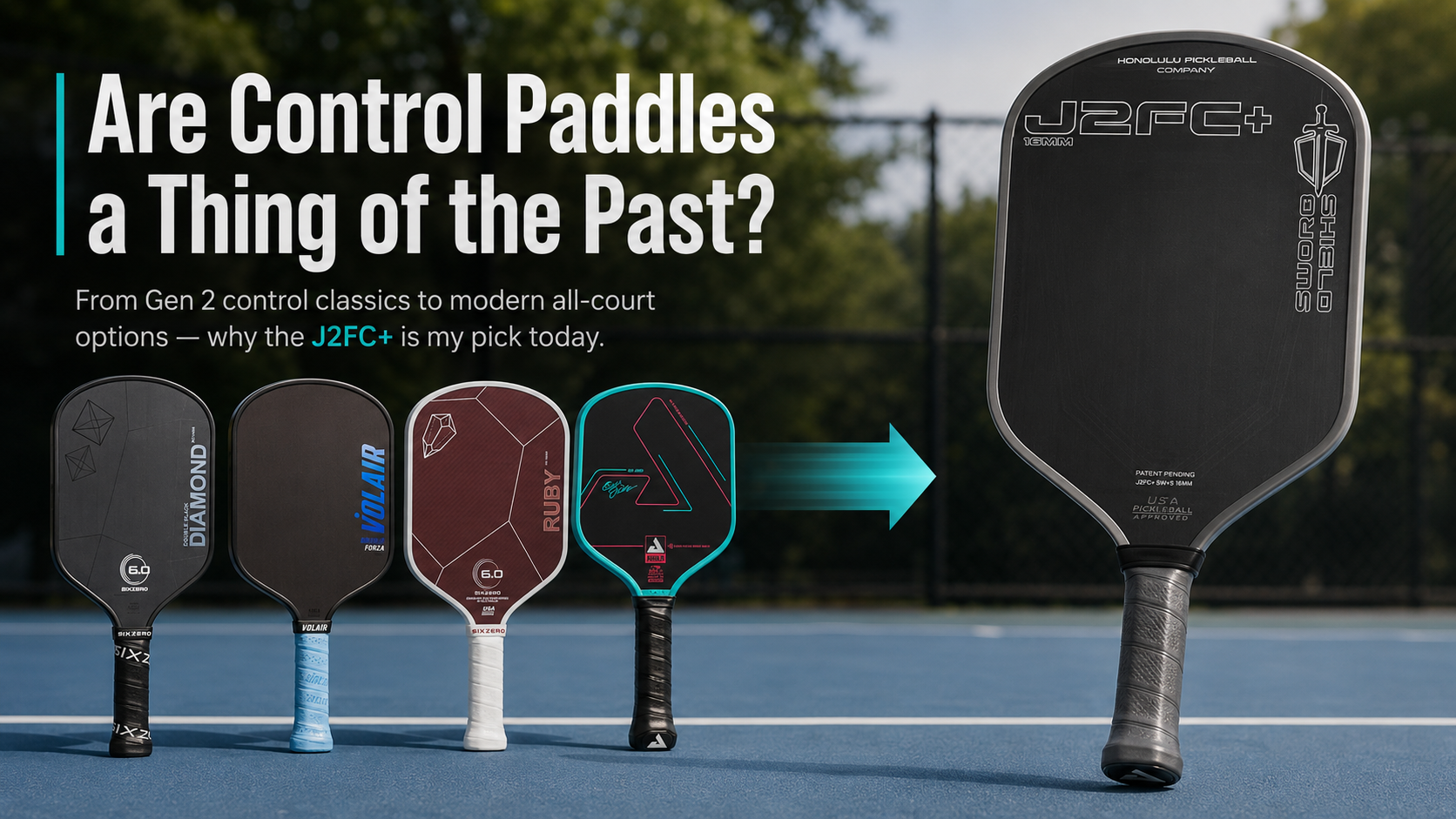
There was a period in pickleball where choosing a paddle felt relatively simple. At one end you had power paddles. At the other you had control paddles.
For a long time, I naturally gravitated towards the control end.
One of my first proper paddles was the Six Zero Double Black Diamond 16mm, and looking back it represents a really interesting stage in paddle development. It was part of the wave of thermoformed paddles that gave players more stability and offence than earlier raw-carbon paddles, but it still retained the controlled, predictable feel that made it so easy to trust.
Six Zero still describes the Double Black Diamond around its blend of precision, control and power. The 16mm version uses a T700 raw carbon face, a 16mm polymer honeycomb core and, in its standard weight, is listed at around a 114 swing weight and 6.8 twist weight.
That combination is a good reminder of what many players wanted from a paddle at the time: enough power to attack, but with control still very much at the centre of the experience.
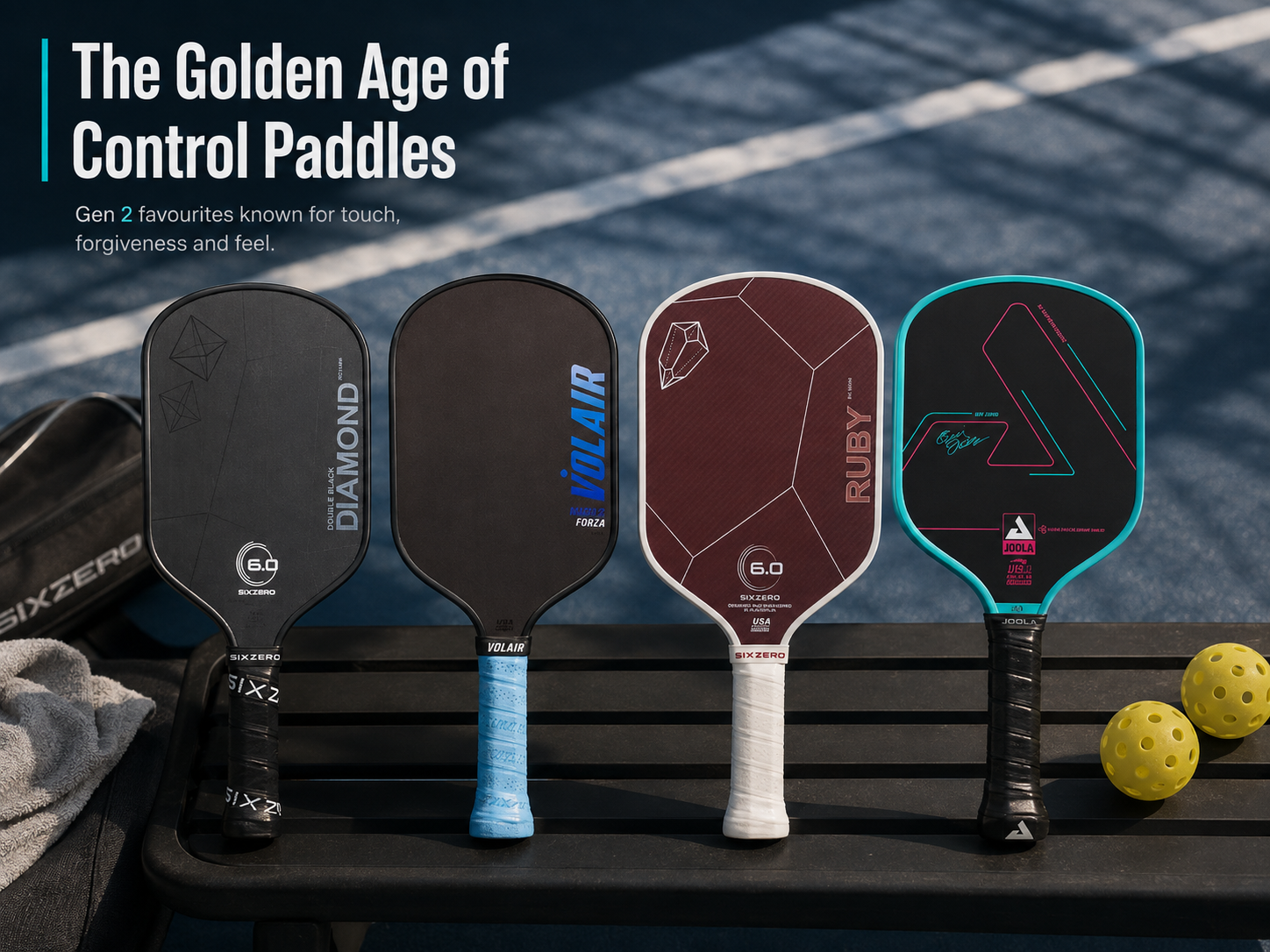
The golden age of control paddles
The Double Black Diamond was far from the only option.
The Volair Mach 2 Forza 16mm became another standout for players who valued forgiveness and control. Its widebody 15.88 x 8.12-inch shape, T700 carbon face, 16mm polypropylene honeycomb core and foam-injected perimeter give it a particularly stable platform. Volair currently lists the 16mm model at around a 112 swing weight and a very high 7.37 twist weight.
That high twist weight helps explain why the Mach 2 Forza feels so forgiving when you do not strike the exact centre of the paddle. It is the sort of paddle that can give you confidence on blocks, resets and dinks because the face feels stable and predictable.
Then came the Six Zero Ruby. It kept a familiar Six Zero hybrid profile but swapped the traditional carbon hitting surface for an aramid-fibre face. The 16mm Ruby is listed at around 8.2oz, a 115 swing weight and 6.8 twist weight. For many players, the appeal was that slightly softer, connected feeling at impact alongside plenty of spin and enough pop to remain useful all over the court.
And then there is the original JOOLA Ben Johns Hyperion CFS 16.
A small technical correction is worth making here: JOOLA now categorises the original Hyperion CFS as Gen 1, not Gen 2. But in terms of the playing characteristics we are talking about, it absolutely belongs in this conversation.
The original Hyperion combined a 16mm polypropylene honeycomb core, Carbon Friction Surface and JOOLA's Hyperfoam Edge Wall. JOOLA describes the returning “OG” version as a paddle built around precision and consistency for control-focused players. It was also relatively heavy at around 8.4oz, which gave it a substantial, stable feel through the ball.
These were paddles you could trust when the point slowed down.
Then everyone started chasing power
Fast forward and the paddle conversation changed.
Suddenly new releases were increasingly about more power, more pop, faster counters, bigger serves and harder drives.
And you only have to look at my own recommendations on this website to see that shift.
My current top three paddle picks are all power paddles.
That is not because I suddenly stopped valuing control. Far from it. It is because paddle technology has moved on to the point where many modern power paddles can give you serious offence while still offering a level of control that would have been much harder to achieve from a genuinely hot paddle a few years ago.
Thermoforming was a major part of that development. Perimeter foam, increasingly sophisticated face layups and newer core constructions then pushed things further. More recently we have seen full-foam and multi-density foam designs become a genuine part of the mainstream paddle market.
The old compromise has therefore become less obvious.
Previously, choosing a power paddle could mean accepting a much hotter, less forgiving response. Choosing a control paddle could mean accepting that you were giving up a significant amount of offence.
Now there are paddles that can sit much closer to the middle.
That is one reason I think the traditional pure control paddle has become less common in players' bags. When you can get substantial power and still have perfectly usable touch, the argument for going all the way to the softest possible paddle becomes harder to make.
But control definitely isn't dead
There is another twist.
The power-paddle era is not over, but the market is showing signs of becoming more balanced.
Pickleball Effect's 2026 all-court recommendations describe the category as paddles that provide enough offence to finish points without sacrificing drops, resets and touch. Its analysis of professional paddle choices earlier in 2026 also highlighted a movement among some high-level players away from maximum power and towards more balanced all-court setups.
That makes complete sense to me.
As players improve, they get better at defending pace. A harder drive does not automatically win the point. You still need the ability to drop, reset, block, dink and take pace off the ball when the situation demands it.
So I do not think control paddles have simply disappeared.
I think the definition of a control paddle has changed.
The question is no longer necessarily:
How soft and controlled can I make my paddle?
It is increasingly:
How much usable power can I gain without giving up the control I actually need?
And for me, that is a much more interesting question.
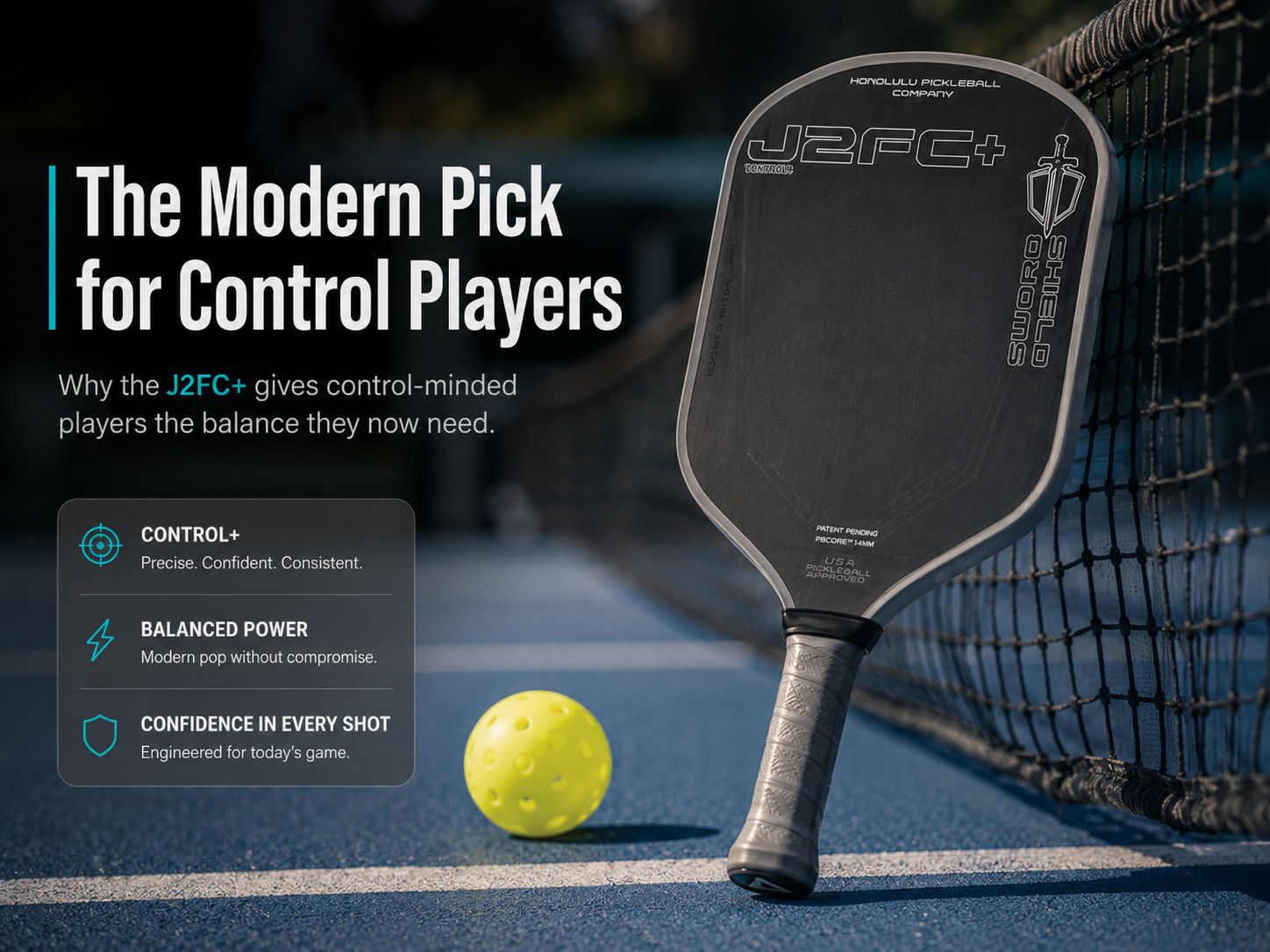
My modern control pick: Honolulu J2FC+
If someone came to me today and said:
“I am a control player. I want confidence on my dinks, drops and resets, but I do not want to feel massively underpowered compared with everyone using the latest power paddles.”
The paddle I would currently point them towards is the Honolulu Sword & Shield J2FC+.
For me, it is a very good example of what a modern control-oriented paddle should look like.
Instead of the traditional polypropylene honeycomb construction used by many older control paddles, the J2FC+ uses a multi-density full-foam core.
Honolulu lists the paddle at 16.2 inches long and 7.8 inches wide with a 16mm core, an average weight of around 8.0–8.3oz, swing weight of 110–114 and twist weight around 7.
On paper, that is a really interesting combination.
The relatively manageable swing weight helps keep it quick during hands battles. The strong twist weight and broader hybrid shape help with stability and forgiveness. And the full-foam construction gives it a different response from a traditional honeycomb paddle.
Honolulu describes the J2FC+ as having increased dwell time, power and pop while retaining a plush, smooth and predictable response.
Independent testing from Pickleball Studio came to a similar conclusion. In its review of Honolulu's foam-core range, the J2FC+ was described as softer and easier to control at the net than the J2NF, with a large sweet spot, good hand speed and balanced rather than extreme power.
That last point is important.
It is not trying to be the hottest paddle on the court
If your only goal is maximum power, there are better choices.
In fact, that is why I would still keep my current top three power-paddle recommendations exactly where they are on the website. Those paddles suit players who actively want offence to be the priority.
The J2FC+ is for a different player.
It is for someone who wants control first, but no longer wants “control paddle” to mean “underpowered.”
You get the softer, more predictable response that helps with:
- dinks;
- third-shot drops;
- resets;
- blocks;
- defensive transition-zone play; and
- taking pace off the ball.
But when you decide to speed the game up, counter or drive through the ball, there is enough modern core technology behind it that you do not feel as though you have brought a knife to a gunfight.
That is the key difference.
Control without being left behind
If you have spent years playing something like a Double Black Diamond, Ruby, Mach 2 Forza or original Hyperion, jumping straight into one of the hottest paddles available can be a fairly dramatic change.
Yes, the extra pace can be addictive.
But if your resets start sailing long, your blocks sit up and you lose confidence in the soft game, more power has not necessarily made you a better player.
The J2FC+ occupies a much more interesting middle ground.
For me, its appeal is the combination of:
- plush and predictable feel;
- large, forgiving sweet spot;
- good stability;
- strong spin potential;
- quick hand speed;
- confidence on drops, resets and dinks; and
- enough offence that you do not feel stuck in the previous generation of paddle technology.
That is why I think it makes so much sense for the modern control player.
So, are control paddles a thing of the past?
No — but the old definition of one probably is.
There will always be players who want the softest, most predictable paddle possible, and there are still excellent traditional control paddles available.
But for most players I think paddle technology has reached a point where you no longer need to make such an extreme choice between control and power.
The best modern all-court paddles can absorb pace when you need them to, stay predictable during the soft game and then give you another gear when you accelerate.
My own top three picks being power paddles says a lot about where the market has moved.
But it does not mean every player should buy a power paddle.
If your game is built around placement, consistency, resets and making one more ball, I would rather put a paddle in your hand that complements those strengths while giving you enough extra offence to compete in the modern game.
For me, the Honolulu J2FC+ is one of the best examples of that balance right now.
Control isn't dead. It's just evolved.
Not sure which paddle suits your game?
Get in touch and I can help you work out what type of paddle fits your playing style.
Ask Kush